

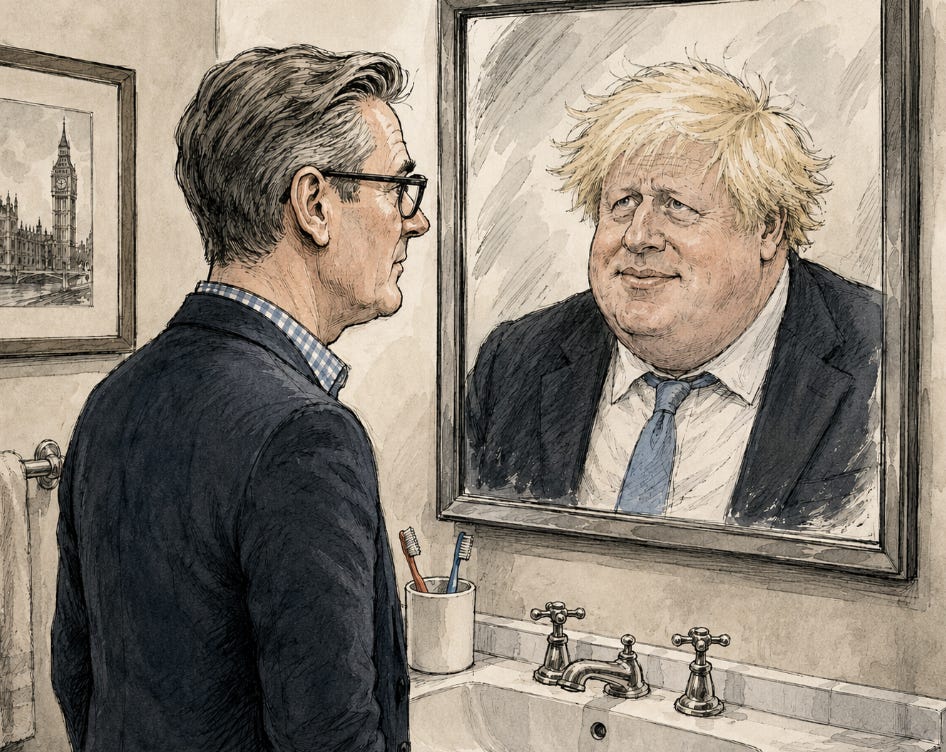
If you’ve been paying attention to my pieces on here, you’ll know that I don’t think the British political system spends enough time assessing the record, character, leadership styles of senior politicians, and thus their suitability for the top jobs. So as we rattle along to our seventh PM in just over a decade, I’ve been spending a bit of time trying to piece together what we can know from Andy Burnham’s relatively long political career. And the more I learn, the more I think he resembles nobody in our recent past so much as Boris Johnson, for good and for ill.
The two men share a tendency to be led by instinct over doctrine, a talent for building coalitions, and a rare capacity to resonate emotionally with an audience. They also share a common vulnerability: a reluctance to bring their own side bad news. Both are men for the big picture rather than nitty-gritty details, happiest channeling grievance and hope into a broad political story. Both seem to be instinctive politicians rather than systematic thinkers, driven by their feel for the public mood rather than a strong set of guiding principles.
There is a neat symmetry here. I’m trying to get this post out quickly because I never got round to writing about the resemblance between Keir Starmer and Theresa May: diligent, procedural, somewhat awkward and diffident with the public. Both lacking a strong sense of personal direction, and compelled to answer what they took to be the essay questions they believed they had been set - on Brexit, defence, immigration - rather than affirming their own personal priorities. The backlashes that prompted the switch from May to Johnson and from Starmer to Burnham look similar too: in each case a desire for more charisma, vision and direction.
Need some convincing? Consider the similarities.
First, Andy Burnham and Boris Johnson share an approach to politics rooted in feeling. A pivotal moment in Burnham’s career - “life changing” in his own words - was his failure to assuage the rage and betrayal felt by Liverpool fans at the 20th anniversary commemoration of the Hillsborough tragedy in 2009. By the 2017 Manchester Arena bombing, he was a changed man, able to speak sensitively and compassionately for the city. And his resurgence to ‘King in the North’ followed his passionate defence of his city region against the perceived indifference of Westminster during the pandemic. He is the best channeler of vibes in British politics at least since Boris Johnson, who could do everything from personifying the sunny optimism of the London Olympics to playing resentful tribune of the people over Brexit. Both men did well in the semi-ceremonial position of city mayor, happy and comfortable in the role of figurehead - and reaping the rewards of being preferred to their national parties.
Second, both are natural coalition builders with unusual reach. In Manchester, Burnham has stitched together local labour power, civic institutions and public leaders around a loose Greater Manchester project. He’s been more pragmatic and less tribal than most Labour figures in terms of trying to develop a cross-party ‘progressive alliance’. And after several years of a Labour leadership that took relish in beating up its left flank, Burnham’s desire to be loved not feared and apparent distaste for factionalism indicates he might be able to bring the parliamentary party back together. Even if he succeeds, it won’t be as big an achievement as Boris Johnson’s unification of (some of) the Tories’ warring factions and putting together a pro-Brexit electoral voter bloc to romp to victory in the 2019 General Election.
For several years, Johnson was routinely described as a ‘Heineken politician’, able to make inroads with parts of the electorate where other Conservatives couldn’t get a hearing - most obviously evident in his popularity in London. Burnham’s success in winning Makerfield - natural Reform territory - demonstrated his ability to win seats no other Labour figure can.
Third, both are ideologically slippery. Burnham’s shape shifting is legendary. Labour MPs have been joking about it for years: “A Blairite, a Brownite, a Milibandite and a Corbynite walk into a pub. ‘Hello, Mr Burnham,’ says the barman.” Johnson was no easier to pin down: economically and socially liberal when it suited him, leaning into protectionism, interventionism and culture wars when that seemed electorally convenient. Neither is a natural political philosopher: expediency always trumps intellectual consistency.
As an ‘ideas guy’, it’s not how I think about politics. But that doesn’t mean it’s wrong or ineffective. There is a practicality, an ability to sense and grasp the political moment and win people round that is critical to both politicians’ success. It’s perhaps not a coincidence that Burnham seems set to pick up Johnson’s stalled ‘levelling up’ project - addressing regional inequality is exactly the sort of thing that a politician feeling their way through public life, seeking out a program that can unite a sizable majority of the public is likely to alight on.
They do share one trait, though, that particularly worries me, and risks undermining Burnham’s time in office as it did Johnson’s: their people pleasing tendency. Tony Blair shares some of these tendencies - he could also capture a vibe, sell a vision and make surprising allies - but he was willing to be hated by his own side, picking fights on Iraq, tuition fees, foundation hospitals. Johnson lacked that toughness. Does Burnham have it?
There’s reason to doubt it. Joshi Herrmann’s rich recent Manchester Mill profile concludes that Burnham “wants to be liked and he’s not particularly ruthless”. Burnham is warm and emotionally fluent and easy to like, but weak on detail: drawn to the big gesture, and reluctant to ask the awkward questions that turn a bright idea into workable policy. (The much-praised Bee Network buses, he notes, were a scheme Burnham inherited and fronted rather than built.) The portrait is of a man very good at being liked, but without a steely grip on detail or much of a plan for the hard trade-offs.
Challenged on his tendency to take the path of least resistance by the New Statesman’s Ailbhe Rea, Burnham apparently bristled and reeled off the risks he’d taken, from facing up to critical voices at the Hillsborough anniversary to taking up the cause of infected blood victims. But as Rea observed, those were popular fights - not confrontations with his friends and allies.
I expect most readers will take the parallel between Burnham and Boris to be ominous and unflattering for the soon-to-be PM. I’m not so sure. I think Johnson was closer to succeeding in Downing Street than almost any recent incumbent. Levelling up was a more substantial undertaking than its critics ever acknowledged, generating a heavy-duty white paper, the institutionalisation of concern for regional inequality within government, and baby steps towards progress. In the policy areas I tend to follow, Johnson catalysed real progress on obesity, animal welfare and agricultural reform. It’s not that he became a policuy nerd overnight, but in various areas he set a vision, picked a direction, and got the machinery of government moving. At his best, he recognised his limitations and delegated - bringing in Andy Haldane to lead on levelling up, for instance.
Johnson’s fatal flaw was that he lacked focus. Dominic Cummings’ memorable description of a “shopping trolley” careening from one position to another, switching views depending on who he last spoke to, ought to be his epitaph. His government foundered as he struggled to maintain a consistent set of priorities and didn’t have the discipline to convert a broad mission into an operational plan of action. A leader has to say no, but that proved too hard for an inveterate people pleaser.
The very qualities that made Johnson such a formidable campaigner undermined his governing project. He was was unwilling to disappoint people, incapable of sticking to painful choices and too easily buffeted by colleagues, events and moods.
Burnham has similar failure modes. He, too, is impulsive and plays to the crowd, with a tendency to prize performance over delivery. His record in Manchester displays some warning flags: bold targets set and missed, on homelessness, clean air and health - promises that ran ahead of institutional design. Setting your sights high might mean missing the failures under your nose.
At the same time, I’m more optimistic that Burnham can overcome his flaws than Johnson could. Crucially, he is more serious: more decent, public spirited and less scandal prone. It isn’t his natural forte, but he appears to be more willing to roll up his sleeves and do the dirty work of policymaking. Most importantly, Burnham seems to have a degree of humility. The most encouraging thing I’ve read about him is Diane Coyle’s assessment: “he’s very self-aware about not being a policy wonk himself…He has a clear set of values…He listens to people”.
That kind of self-knowledge could be his saving grace. The way to survive being a big picture politician who isn’t good at the detail is to find people who can and who you can trust. Johnson never quite got the hang of this trick. I obviously think Jurgen Klopp is the greatest leader of them all (and even the Evertonian Burnham might grudgingly agree), but his genius lay in this ability to bring in and defer to specialists - from data analysts to specialist throw-in coaches. The new Prime Minister should take notes.
If I were Andy Burnham, I would try to set aside a bit of time in the coming weeks to study the Boris Johnson premiership: its successes, near misses and dysfunctions. If he can see past his political antipathy, he might recognise something of a kindred spirit. Fail to heeds its warnings, and I fear history will repeat: tough decisions ducked, an effort to be all things to all men, and boosterish bluster that fails to cover minimal concrete achievement. But if he learns the right lessons, Andy Burnham could fulfil the promise that Boris Johnson hinted at in his best moments: shifting the mood of the country in a more optimistic direction, bringing a broad coalition together and making tangible progress towards the sunlit uplands.
you have expressed my thoughts too
Sorry not to engage with the actual post yet, which I'm sure is insightful, but... where on earth is that image from? It's AI, right? In any case, it's truly awful. Surely if an image is absolutely necessary, there's still a better way than this.