
Read/Watched/Listened/Ate
22: June 2026

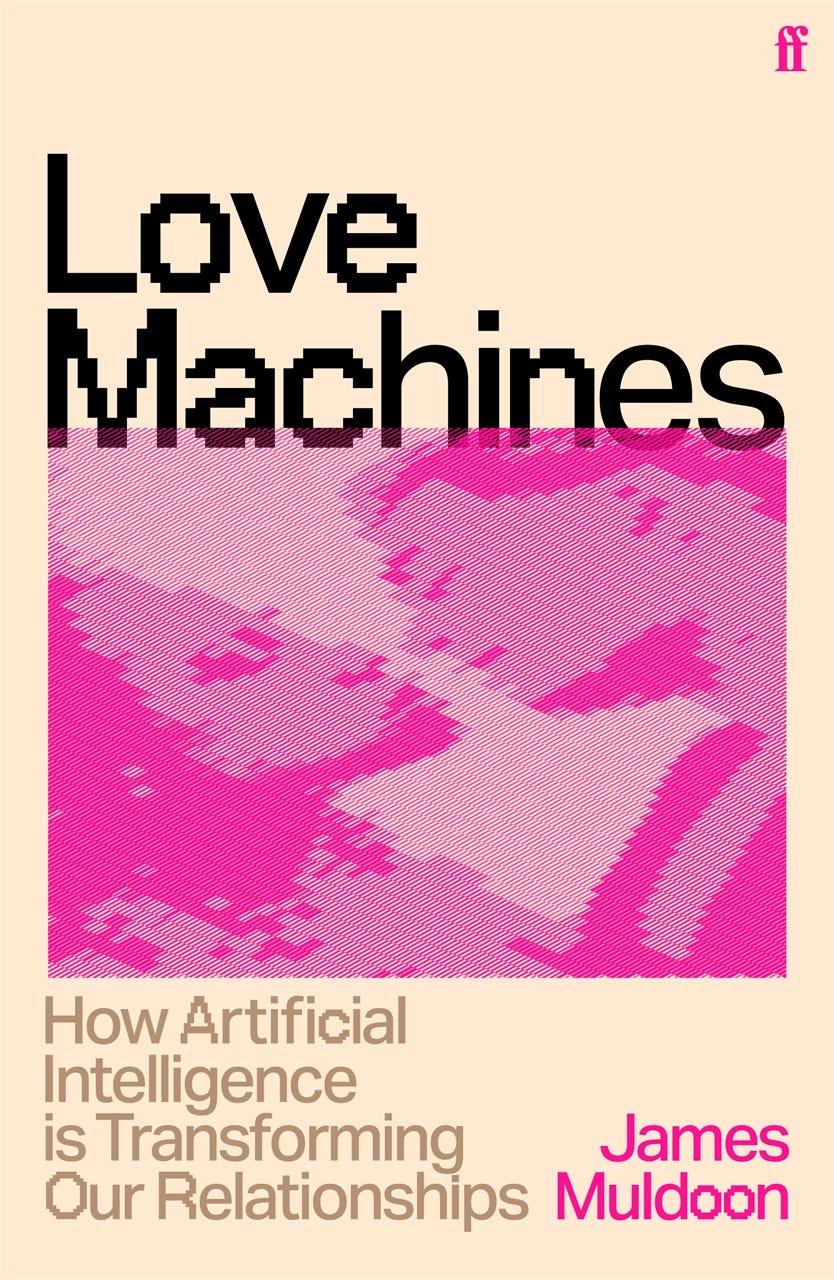
Book (1): Last week, I read Love Machines by James Muldoon, a book about how AI is changing relationships, with chapters on companionship, sex, mental health and grief. For a while, I’ve thought this is one of the most significant and underestimated questions in AI prognostication. A lot of the discourse suggests that AI will never be able to replace the ‘human touch’, whether that’s a doctor’s bedside manner, the personalised attention of a teacher or the help of a carer - the machine will always benefit from a face at the front. In a service economy, that’s quite reassuring. However, I don’t think we can be confident it’s true: with thousands of people already getting emotionally vulnerable with, falling in love with, wanting to adopt children with(!) AIs, I don’t think we can assume anything - especially since existing systems might only be primitive versions of what’s coming down the line. Muldoon is careful, balanced, open minded - in less compassionate hands this could have been presented as a freak show. He does a decent job of explaining the appeal of AI relationships - of course people are attracted to convenience, control, undivided focus on them, and having their own perspective affirmed and repeated back to them. But Muldoon also identifies the dangers: while the technology could help people some people practice and improve for real human relationships, it risks deepening others’ isolation by making the virtual world too comfortable. Still, he never quite seems to shake the presumption that AIs are second best to the ‘real thing’ that humans provide - which seems far from inevitable to me. For example, he cites a study that compared transcripts of human vs AI therapists, and concluded they were basically indistinguishable - yet he insists AI lacks “the depth of genuine human connection essential to therapy”, and that therapists will be better because they can pick up on subtle, non-verbal cues. Maybe…but I worry this overstates our knowledge about how or why human therapy works. Are we sure therapy needs human connection after all? How reliably do human therapists actually pick up on these subtle clues? The possibility that AI could surpass us - that it can be warmer, more reassuring, less self-absorbed, more patient than us flesh-and-blood humans - doesn’t seem that far-fetched to me. And if so, I’m very uncertain how far AIs will enhance or replace human relationships (probably both, but in what proportion?)
Book (2): I also read A Swim in a Pond in the Rain by George Saunders. It’s a series of short stories by Chekhov, Turgenev, Tolstoy and Gogol, accompanied by Saunders’ commentary, based on Saunders’ creative writing course. I love stuff like this, and wish there was more of it - deconstructing and explaining the craft and intention behind works of art in an accessible way.1 I would have got half as much from reading these stories on my own without Saunders’ scaffolding. I wouldn’t exactly say I was convinced on all of them, but I came away with a clearer idea of what they were trying to do, and why Saunders loved them. And it helps that Saunders is such a warm, enthusiastic and plainspoken guide - he is disarmingly frank about the things that make these stories boring, dry, confusing or off-putting, and what we can learn from them anyway. Of the four writers, Tolstoy resonated most with me - the most didactic, moralistic and schmaltzy of the stories, but - as Saunders emphasises - not as simple as they seem.
Article: Why do Mainstream Parties Lose Either Way on Accommodating the Far Right? by Hanno Hilbig (Popular by Design). Interesting - if somewhat equivocal - analysis of one of the most important political questions of the moment - how to defeat the far right, and defuse the toxicity over the issue of immigration. The punchline: more often that not, ‘accommodation’ to the concerns of voters via a hard line approach on immigration is counterproductive because it is hard to avoid raising the salience of migration, to avoid damaging losses to more consistently pro-migration parties and to persuade migration sceptic voters you have really changed. Denmark may be the exception that proves the rule, but it seems exceptional. I found the piece interesting for its approach as much as its conclusion - as I’ve said before, we don’t have enough rigorous analysis that connects policy to electoral outcomes. This stuff is hard to study, but Hilbig describes some methods we should see more of, in my view: exploiting variation in candidate positions, conjoint designs and survey experiments that give people information about different party positions and monitor voter preference. And perhaps the most interesting, natural experiments like Keir Starmer’s ‘island of strangers’ speech, which raised the salience of migration right in the middle of the fieldwork of a poll, offering a clean before and after.
TV: I finished the outstanding final episode of Hacks (Sky), the comedy-drama about an unlikely friendship between an ageing stand up comedienne and her younger writing partner. As sometimes happens, I suspect the idea for the finale had been brewing for a while - it was a big step up relative to the rest of the (still decent) final series. Without giving too much away, it finds humour in the darkest of topics - because comics can’t help it - and continues to pay tribute to the joy and sweat and necessity of working with someone who gets the most out of you to produce work you’re really proud of.
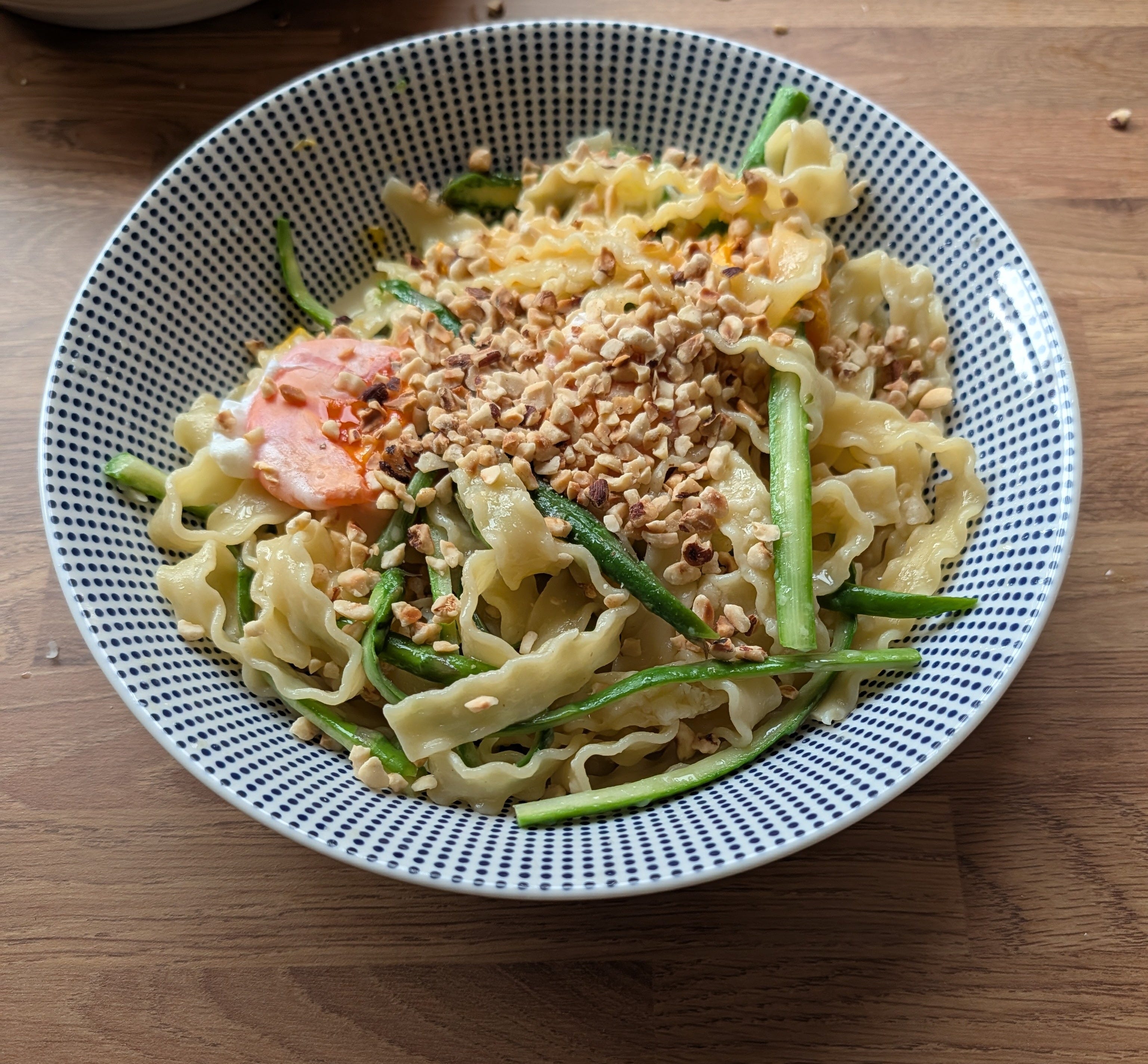
Food: Mafaldine with asparagus, poached eggs and hazelnuts. I’m still on asparagus, so made this simple, but rich and tasty dish. Piedmontese in inspiration (apparently the region is known for asparagus and hazelnuts), though it turns out the pasta is Southern (sorry, it’s what I had in the house).
“Explain what’s good about this thing/why people like it” is a great AI use case, in my experience - especially in art museums. Enhanced my experience of the Guggenheim Bilbao about 50%.
Hardly an original rec but it sounds like Saunders’ Lincoln in the Bardo would tick a lot of your boxes