
Read/Watched/Listened/Ate
25: June 2026

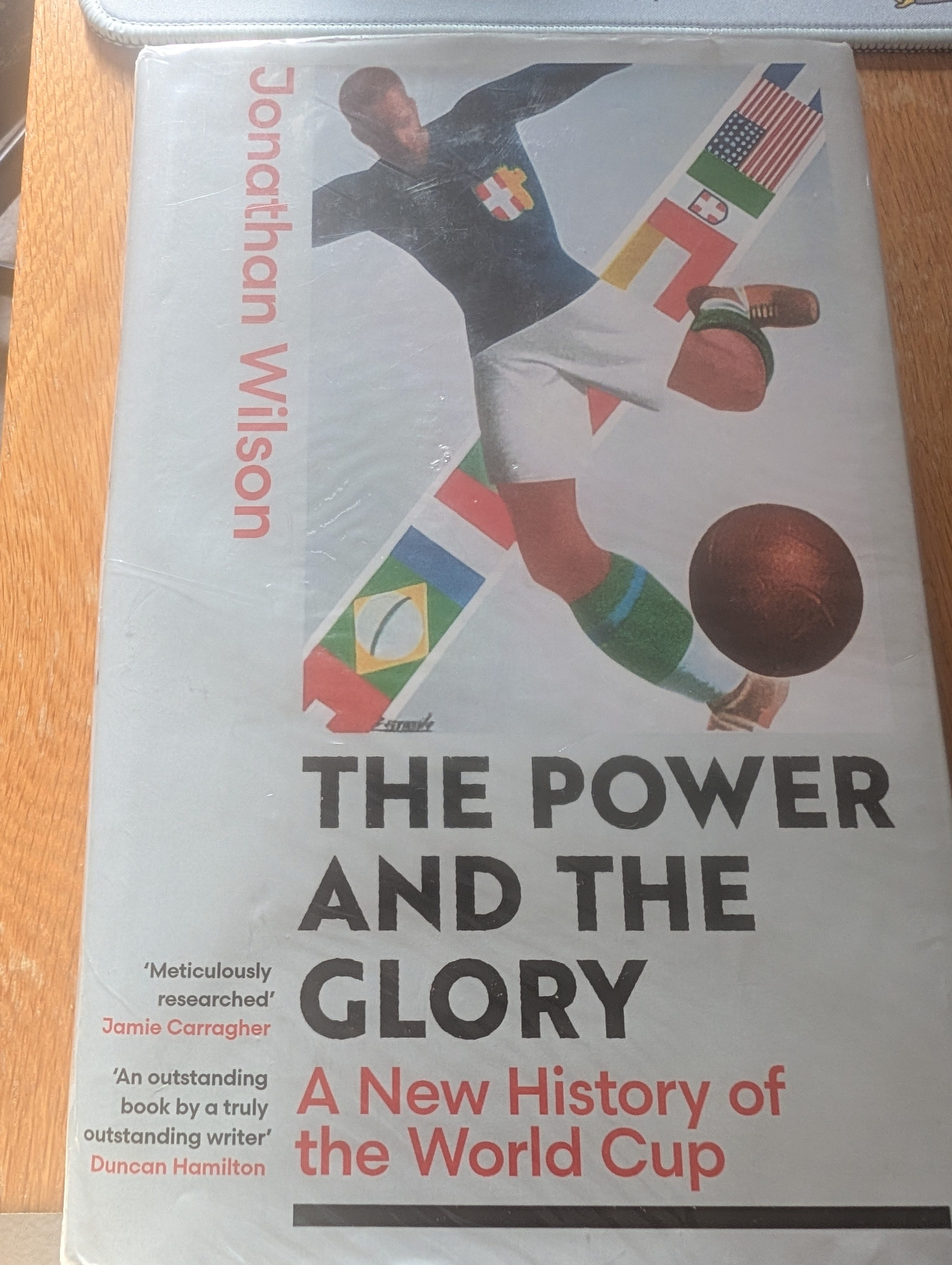
Book: Last week I read The Power and The Glory by Jonathan Wilson, which I think is already the definitive history of the competition (with apologies to Brian Glanville and Michael Coleman). Wilson is many things - tactics writer, reporter - but above all he is a historian, and he has the historian’s nose for quirky detail, odd connections and the macro trends that sit behind events. It is something of a shame, then, that my conclusion from the book is that the World Cup is overrated. A through line of the book is that the World Cup has always been the way it is today: chaotically managed (it was a struggle to get teams to enter in the early years), politicised (they didn’t play national anthems for most of the 1966 World Cup so the UK could avoid recognising North Korea), and exploited by unsavoury regimes (Mexico 1970 and Argentina 1978 both took place in the shadow of human rights abuses). The cliche is that we can overlook the off-field ugliness because of the beauty on the pitch, but we shouldn’t exaggerate the quality of play either. Wilson is clear eyed about how dull many tournaments have been, how the quality has lagged behind the club game, and how often caution and defensiveness have trumped skill and flair. The World Cup has rarely been the tactical vanguard of the sport - the most interesting teams of the past 60 years - the Netherlands in 1974 and Spain in 2010 - were later and less effective versions of club teams (the total football of PSV and Ajax, the tiki taka of Barcelona). I’m also sceptical that the World Cup brings people together and fosters benign nationalism. As often, it has inflamed tensions and encouraged bigotry, from the soccer war between El Salvador and Honduras in 1969 to troubled matches between England and Argentina after the Falklands War. The reality is that it is in club football that players from all around the world rub shoulders, that fans are all but forced to cheer for players from a diverse set of nations, and cultures and poured together into a melting pot (or, as Michael Cox would put it, the mixer). I’ll still watch it1, but the notion that the World Cup represents the best of football, in any sense, seems clearly wrong to me.
Paper: Political Identity Beyond Politics: The Messi-Ronaldo Preference Across 26 Countries by Ahmed et al (SSRN). When I wrote about Mohamed Salah a few months back, the thing most people commented on was my reference to a survey that showed that people on the political left preferred Lionel Messi to Cristiano Ronaldo, and those on the right felt the opposite. Fun news: a new paper surveying people across 26 countries replicated the finding, with political ideology the strongest individual-level predictor of preference for one footballer over the other. Those who get their news from short-form video, and who have a stronger sense of self-esteem are also more likely favour Ronaldo, while more cognitively reflective people prefer Messi. Also South Koreans yield to nobody in their distaste for Ronaldo. There’s a lot here, and a lot of fun room to speculate: clearly Messi’s quiet, humble, less individualistic approach resonates more with those on the liberal left. But as some people pointed out to me, it isn’t obvious the sorting would work this way: we could imagine a world in which Messi’s collectivist, family values values, his divinely ordained gifts would appeal more to the right. Yet those values feel almost quaint in the current political context, harking back to an earlier conservatism. Intriguingly, the effect of political Messi-Ronaldo divide was stronger among younger people, perhaps signposting the direction of political arguments for years to come.
Podcast: The Levellers (In Our Time). In Our Time, the delightfully anachronistic BBC radio show where academic experts are interviewed on a different topic each week, has held up remarkably well in my view after losing its iconic host Melvyn Bragg. This episode begins with (I think) the very reasonable claim that the intellectual influence of the English civil war is underestimated, and discusses one of the more interesting movements that emerged in that period. The Levellers were quashed pretty quickly in the 17th Century, but I left persuaded that they were more strongly committed to the idea of basic human equality than almost any political group before them - which makes them an important part of the story of moral and political progress.
Live Music: I went to see Belle & Sebastian at Piece Hall in Halifax, performing the entirety of the album If You’re Feeling Sinister to mark its 30th anniversary. As a birthday activity I can recommend going to an event where people a bit older than you are feeling nostalgic for something you don’t remember from first time around to make you feel young. I would have preferred a 20th anniversary performance of The Life Pursuit, an album I recall vividly from my final months at school, but the one song they performed from that album - Another Sunny Day, a song set in midsummer, played on a midsummer night - was perfect. It was also my first time in Halifax, which is beautiful! Grand sandstone buildings set against the spectacular natural setting of the Pennine Hills. And part of the draw of this show was the venue, an 18th Century cloth market, with a large open courtyard that reminded me as much as anything of Somerset House.

Food: I’ve already sung the praises of Skosh (York), but I’ll do it again since I hired out the private room with some friends for my birthday. On theme, they’re celebrating their birthday too (10 years), and have been putting on a ‘greatest hits’ menu of the best dishes they’ve done so far. As a result, everything was consistently top notch, but probably my favourite thing was the crisp, fluffy potato and hispi cabbage okonomiyaki (Japanese pancake). Outstanding.
Maybe not, if - as seems likely - Scotland are eliminated.