
Read/Watched/Listened/Ate: Alienation
29: July 2026

When work, fame, politics, democracy and fine dining just aren’t what you wanted or expected.
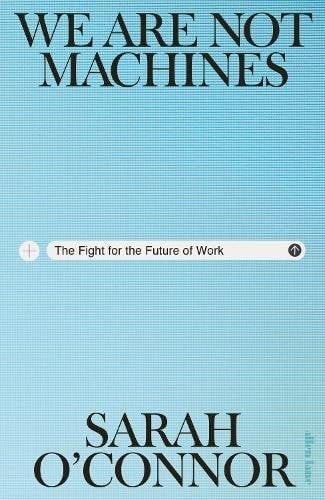
Book (1): We Are Not Machines by Sarah O’Connor. Anything by Sarah O’Connor is an automatic recommendation. She’s been analysing the world of work longer and better than most, so her take on automation and AI is well worth reading, especially as it documents a journey from techno-optimist to a more sceptical position. It is great old-fashioned reporting and story-telling, covering a wide array of job types, sectors and political economies - from Hollywood creatives to Czech translators to Swedish miners to Dutch care workers to Amazon warehouse packers. The overall message is simple, intuitive, but certainly non-trivial: automation is likely to improve work if it increases job autonomy, if the worker controls how and where it is used, rather than having it dictated to them by their manager. Thinking about the future of AI has a tendency to make me think that Marx was right, just premature, and this is a book about a very Marxian concept: alienation. In particular, the phrase that recurred in my head, the dystopian spectre that haunts the book, is Marx’s metaphor of the worker as “an appendage of the machine”. O’Connor ends by promising that “The future of work can be more worthy of the human mind, more careful of the human body, more satisfying to the human soul. But not without a fight”. Let’s hope it doesn’t require a revolution.
Book (2): Famesick by Lena Dunham. A few months back, I started re-watching the TV series Girls, and was stunned by how well it holds up. Not only is it still genuinely hilarious, but it has a preternatural wisdom and a self-awareness that seems extraordinary from someone so young. Reading Lena Dunham’s memoir of putting the show together, things started to fall into place. To begin with, the echoes to her own character and relationships are so strong that it sometimes seems like the show was a documentary. But also I now understand that it was a show about being in your early 20s in early 2010s, like I used to be, co-written by someone in their late 30s, as I am now. Of course it works for me! The gossipy name-dropping and behind the scenes stories are fun. Adam Driver is as magnetic and faintly terrifying on the page as he is on screen. The second half of the book, about Dunham’s successive gynecological and mental illnesses is more of an ordeal, though she never loses her humour. She is hard work, but you feel a bit bad for thinking that. There is a sense it got too much for Jack Antonoff (a guy I had barely heard of a couple of years ago but now am getting massive Baader-Meinhof syndrome for) - though frankly he seems like a bit of a nonentity in the book. One other small motif that naturally stood out to me: London as a glamorous escape for American women of a certain cultural milieu (see also: Taylor Swift and Olivia Rodrigo). I’d love to read more about that, if only to understand why our wee corner became culturally relevant again. On the other hand, I could watch Too Much, and didn’t beyond the first couple of episodes, so revealed preference suggests otherwise.
Article: What 1,000 hours of right-wing media taught me about persuasion by Liam Evans (Labour List). “Over the last two years I have spent over 1,000 hours watching GB News, listening to podcasts like TRIGGERnometry, reading Rupert Lowe’s X account, consuming conspiracy theories, and scrolling through some of the deeper, darker, less mainstream parts of the alt-right’s internet”. Sounds awful, are you OK? I don’t think the core insight of the piece - that appeals to identity and affinity are more effective than direct argument - is mistaken, though it seems premature to conclude that the right is simply winning and the left is necessarily behind. What is alarming to see laid out in this fashion is the way that right wing media stokes outrage and anger, exploits conspiratorial thinking, targets people at moments of tired and fed upness. Evans suggests that the left would do well to imitate some of these tactics, and doubtless it would, but aside from the partisan dimension I worry about the affective compromise. What our politics needs is optimism, purpose, cooling impulses, encouraging perspective taking, all of which is harder than the pandering that seems profitable.
Podcast: The History of Bad Ideas: Deliverism (Past Present Future). David squared (Klemperer and Runciman) is always an instant recommendation from me, and particularly on such a significant and topical issue as deliverism - the idea that governments should simply prioritise achieving good outcomes in order to get re-elected. Longstanding readers will remember my second ever post compared deliverism to alternative theories, and I’ve also specifically discussed David Klemperer’s views on the topic. Yet there’s still more to say. Runciman asks reasonably whether deliverism is banal and obvious, but I think they get to the point that it is problematic when it substitutes for ideology or belief systems. He also asks whether it involves an obsession with quantifiable metrics, and I’m more inclined than Klemperer to think that’s a mistake: deliverism is about achieving whatever outcome voters care about, whether or not it is measurable. Consider this quote describing would-be Chancellor and still Home Secretary, Shabana Mahmood:
she starts from the position that voters are angry and 90 percent of the time, they are right to be so. She believes her job as a politician is to be a kind of “engineer,” this person said — to “look at where they’re right to be angry about what’s not working inside an institution.”
This strikes me as a very deliverist viewpoint: if (say) GDP has gone up but people remain upset, government must not have been optimising for the right outcome. Given the forum, it might have been interesting to dig deeper into the intellectual history of the deliverism-popularism dialectic, which I’d be inclined to trace to the 1960s political science debate between Anthony Downs (whose median voter theory strikes me as a forerunner of popularism) and Donald Stokes (whose account of valence politics I take as anticipating deliverism). I think they could also have made more of the most confounding failure of deliverist theory: the apparent refusal of voters to give politicians credit for a dramatic reduction in crime. But overall, a compelling discussion of one of the key political questions of our time: are governments rewarded for effectiveness?
Food: I had maybe the most expensive meal I’ve ever had (certainly that I’ve paid for out of pocket) at A. Wong (London) (wedding anniversary). It was the first Chinese restaurant outside Asia to achieve a Michelin star, and it seems pretty plausible to me that it’s the best dim sum in Europe, certainly the best I’ve ever had. Was it 4x better than the next best, reflecting the price premium? No - but that’s often the way with top restaurants. The trouble is that it didn’t quite feel as fancy an occasion as you would expect for that money either. The location - in an extension, facing out onto a pretty ordinary street in Victoria - hardly felt high end (though in part this is part of the myth of place: head chef Andrew Wong took over the site from his parents’ old Chinese restaurant). Food was good, service was attentive, vibe a bit more ordinary and casual than I would have hoped. High quality, not great value for money. But you don’t know if you don’t try, I’m fortunate enough to be able to splurge every now and again, and food is my biggest vice.