
Read/Watched/Listened/Ate
4: January 2026

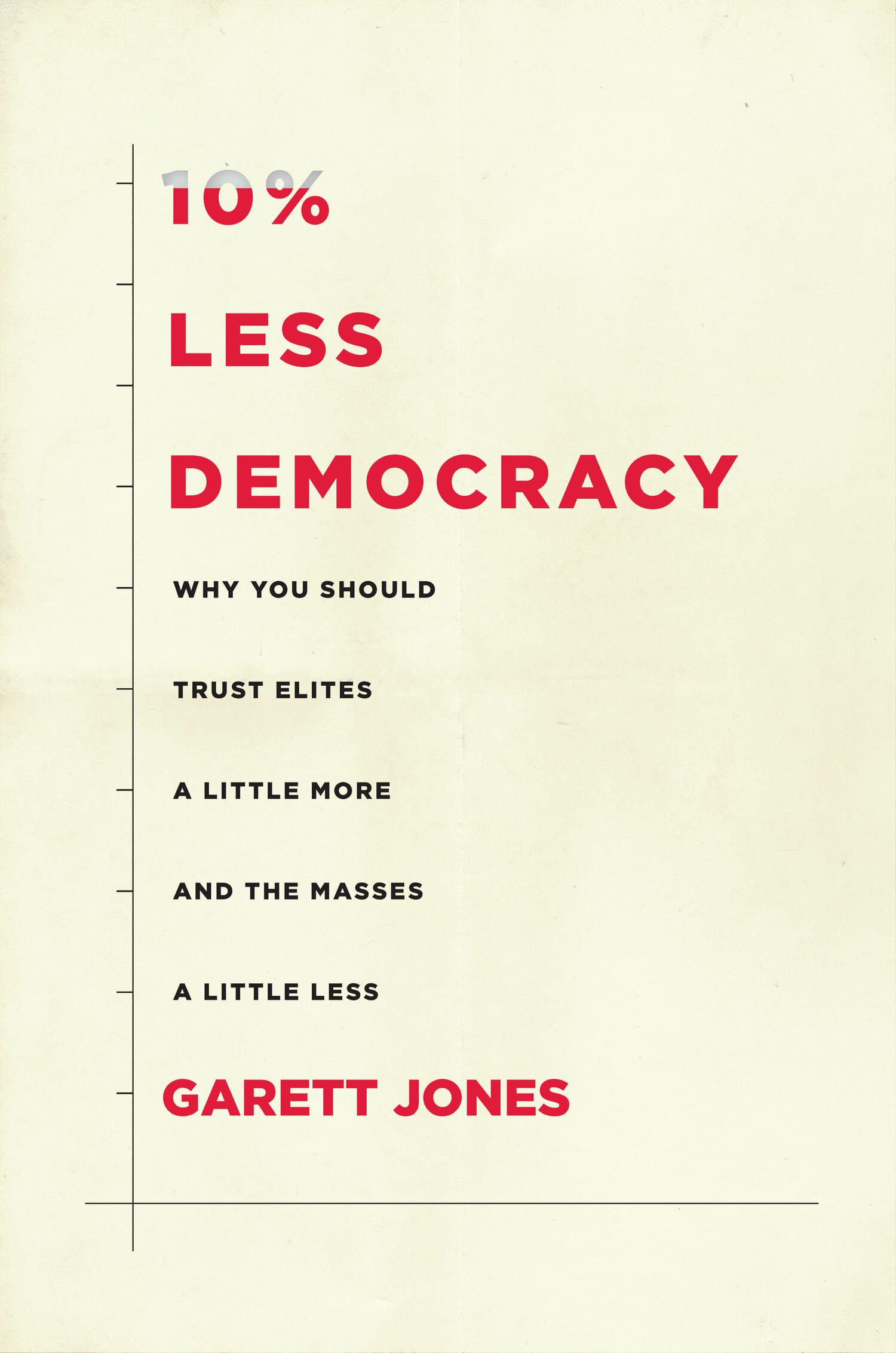
Book: Last week I read 10% Less Democracy by Garett Jones. As the title suggests, it's a book that does not deny the value and importance of making political decision makers accountable to the citizens they rule over, but argues that we can keep most of those benefits and achieve better outcomes by delegating a bit more power to elites. Its a provocative theory, but carefully argued, understandably not trying to push too hard. A lot of his examples seem reasonable, obvious even: central bank independence is a good idea, regulators shouldn't be politicised, the judiciary should be appointed not elected. More challenging is his argument that we should restrict the electoral power of less educated voters - for example, by drawing larger electoral districts in areas where they are more numerous so as to dilute their vote. It's interesting to contrast his argument with David Klemperer's recent push for mandatory voting: it seems that a wider electorate is one less technically capable, but better able to defend the interests of the most vulnerable - and their disagreement likely reflects Klemperer's egalitarianism compared to Jones’ free market inclination. More generally, Jones takes a very broad conception of what a “better outcome” entails - relatively uncontroversial goals like GDP and life expectancy, though he also smuggles in his prioritisation of economic freedom over other objectives. Yet many of our political decisions involve less clear value trade-offs - cultural homogeneity or multiculturalism, a more punitive or compassionate approach to criminals - that we need democracy to resolve. This book strengthens my conviction that national votes are not an especially effective way to resolve these questions, but my takeaway is that we should care about quality as well as quantity of democratic engagement to more effectively resolve these sorts of issues as a policy.
Article: Pro-Social Media by Dylan Matthews (my new colleague at Coefficient Giving) made a compelling case for why AI might restore a shared reality via an established set of facts, strengthening democracy and weakening fraudulent conspiracy stories. He quotes and defends the philosopher Dan Williams’ argument that “Whereas social media democratised information, LLMs technocratise it”.
Film: I watched Anora, thought it was fine but didn’t get the hype. A lot of unpleasant people shouting at each other, and not quite funny enough to justify it.
Music: Lately I’ve enjoyed the album Love and Fortune by Stella Donnelly. She belongs in a category with Courtney Barnett, who she has cited as an influence, and not just because they are both caustic Australian singer-songwriters. But in Donnelly’s the cutting lyrics are softened with a bit of sweetness.
Food: I was in Paris last week for work, but mostly ate relatively unremarkable food near the conference centre. I did try French onion soup at Le Bois - to be honest, it's something I've never really got into, and eating it in France didn't really change my mind. The house cocktail was very nice through - Laphroaig, raspberry, cranberry and lemon juice (yes I went all the ay to France to drink Scottish whisky).