
Read/Watched/Listened/Ate
26: July 2026

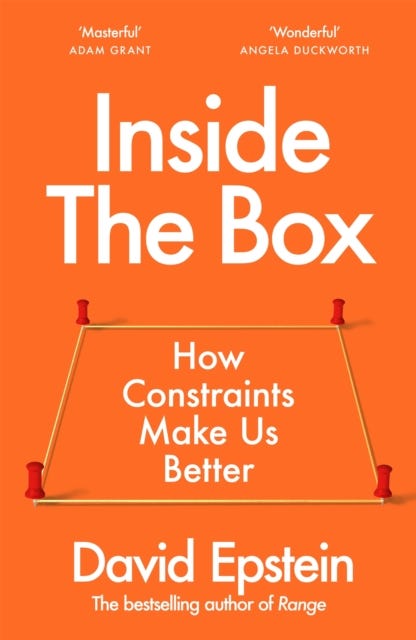
Book: Last week I read Inside the Box by David Epstein, which tries to explain how constraints help people be effective, creative and collaborative across business, arts, sport and society more generally. It’s a fine example of pop science writing, weaving together scientific evidence with a litany of fun illustrative stories. The central case at the heart of the book is Mendeleev’s discovery of the periodic table - which, according to myth came to him in a dream, a supposed illustration of the power of random inspiration, when in reality it was accelerated by his need to finish some diagrams to meet a book deadline. The patron saint of the book is Herbert Simon, godfather of behavioural economics, and proponent of ‘bounded rationality’ and ‘satisficing’ - doing what is good enough rather than seeking perfection. Simon also loomed over my PhD, which - like Epstein’s book - was interested in the drawbacks of choice. So I’m very sympathetic to the core argument that constraints can be productive - I mean, I write these posts on a weekly basis to force me to record and refine my thoughts rather than passively consuming stuff. At the same time, I worry that Epstein is arguing against a bit of a straw man (though it’s a view he himself seems to have held at an earlier point): the extreme view that total freedom is the idea. In practice, the question we usually face is how much constraint is necessary without crushing joy or initiative. Abolishing management is unhelpful, but micro-management is bad too. I’m not sure Epstein is that much use in striking the balance. Epstein also hints at the political implications of his ideas without pursuing them. There’s something a bit post-liberal about the idea that we in modern society have too many options without the tethers and guidelines that orient people and keep them grounded. But what does that practically mean? Should we use law and politics to reinforce cultural homogeneity and social norms, from support for religious organisations, traditional families etc - or is that too far, and why? Epstein implicitly raises these sorts of questions (he even cites Durkheim!), but given the genre I suppose it’s fair enough he doesn’t resolve them.
Article (1): The Doomers Are All Right by Ozy Brennan (Asterisk). I move in circles where it is not uncommon for people to believe there is a huge risk of human extinction or a similarly catastrophic event in the next few years. It’s a bit of a head trip, to put it mildly. So I appreciated this piece trying to understand how people feel about such possibilities, and how they continue to live their lives. The responses are surprisingly mature, sympathetic and even wise. Maybe this shouldn’t be a surprise. After all, we are all living with our mortality and it is hardly uncommon for people to have terminal diagnoses that mean they have to face death every day. And as far as I can tell the best way forward is to keep going, perhaps with a greater appreciation of the things that make life precious. Cliches are cliches for a reason.
Article (2): Should People Avoid Whole-Body Screening Info? by Scott Alexander (Astral Codex Ten). I’ve been annoying people for a while (particularly since I read The Age of Diagnosis at the start of the year) arguing that excessive medical testing of otherwise healthy young people is often likely to do more harm than good. This is counterintuitive - more information usually seems better. Yet in many cases, screening is more likely to pick up something benign that causes unnecessary anxiety and treatment than actually. That’s the argument the UK’s National Screening Committee recently made to resist campaigns for mass prostate cancer screening in men. So I found Scott Alexander’s back of the envelope analysis as to whether full body screening is worth it valuable in sharpening my thinking. I was struck by how finely poised the balance of reasons is, with substantial uncertainty and reliant on judgement calls. That suggests the value of screening will really vary depending what specifically we are testing for.
Podcast: Stefan Dercon on Implementing Elite Bargains (Africa Urban Lab Podcast). Four years ago, Stefan Dercon published a book arguing that ‘elite bargains’ - whereby the powerful members of a society agree to invest in the productive economy rather than squabbling over rents - are necessary to support growth in poor countries. In this interesting discussion, describes the process of taking that idea outside of the academy and attempting to actually facilitate some of those bargains via governments. It’s a tricky task, having to be pragmatic in terms of the governments you work with and the policies you pursue, while recognising the risk of being used by governments that don’t want to change. Dercon’s own unwilling celebrity in Pakistan as he tries to relax import controls highlights the perils of navigating those choppy waters.
Live Comedy: I saw Stewart Lee vs the Man-Wulf (Grand Opera House, York). I laughed a lot, the main thing. He’s still technically excellent. He’s still meta. He seems to do fewer interminable sections where he repeats the same joke. By this stage, he seems bored by conventional stand-up and it feels like he’s setting himself challenges to stay interested (the sort of creative constraint David Epstein would love?) . What was striking about the set was the number of different comedic styles he took on - not just three different personae of different political perspectives, but a few turns at visual and slapstick humour. It didn’t all work for me, but I’m not sure I would expect it to. Still a good time.