
Read/Watched/Listened/Ate: Pessimism and Progress
32: August 2026

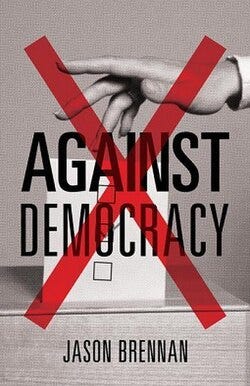
Book (1): I read Against Democracy by Jason Brennan. If you’ve been following closely you may have noticed quite a lot of my reading in the past few months has exemplified what we might call ‘democratic pessimism’: Democracy for Realists, 10% Less Democracy, Don’t Talk About Politics. (This is loosely related to an exciting project…more to follow). These books in different ways try to disenchant the reader from the naive or romantic idea of how democracies work, and confront them with the brute reality of ignorant, irrational, capricious electorates. In a sense Jason Brennan is the final boss of this tendency, arguing that democracy is actively bad. He questions the justice of letting voters so casually and incompetently inflict the grave harms a state can do - from impoverishment to imprisonment to (via defence and health policy) literal matters of life and death. He also rejects a tradition going back to Aristotle via people like Hannah Arendt that suggests engaging with politics is in some sense ennobling or good for people, arguing we are in fact worse off for getting involved in political debates - more fractious, tribal and impotently angry. In Brennan’s view, we should pursue ‘epistocracy’ - giving power to those who are sufficiently knowledgeable, for example, requiring people to take a test in order to vote. It’s bracing stuff. I don’t buy it fully, but I do think it forms a powerful argument against a conception of democracy that equates it with voting. I think this dovetails in a way with the more expansive conception of citizenship being promoted by IPPR in recent weeks. They, like Brennan, recognise the responsibility that comes with democratic participation - that the power it gives people should be wielded carefully. Yet where Brennan is sceptical that ordinary people have the enthusiasm and inclination to inform themselves and deliberate carefully, a more optimistic vision of democracy ought to give them more opportunities to rise to the occasion. Most obviously this could involve service in participatory forums, but also potentially taking a constructive role in other civic associations. Does democracy take up too many evenings, or are people willing to put in the time?
Book (2): I also read Love and Other Thought Experiments by Sophie Ward, a book interlocking fictional stories loosely inspired by philosophical thought experiments, probing the nature of consciousness, identity and love. Sounded great in theory, in practice I found it hard to get into, a bit too weird and obscure. Alas, I’m an analytical philosopher at heart, and I like my philosophy a bit more straightforward and less poetic.
Microsite: Ordinary Abundance by Jordan Dworkin. My colleague Jordan works on the Abundance and Growth team, trying to find ways to speed up economic progress. As a side project, he developed this magical and inspirational little site, showing how far we’ve already come. It invites you to walk through a modern apartment, and consider the myriad ways in which our modern world would seem utterly miraculous to people in previous times, illustrated by quotes demonstrating the awe with which people experienced or imagined recorded music, electric lighting, even bicycles before those became widespread.
Podcast: The AI Giants weren’t prepared for this (Ezra Klein show). The politics of AI are evolving in fascinating ways. This interview with Jasmine Sun was an interesting discussion of the dynamics of resistance to datacentres in the US - on the face of it an odd phenomenon given that they are less polluting and disruptive than other industrial land use. It is clear that the datacentre fight is a proxy referendum on AI and demonstrates the failure of AI companies to persuade people their technology is actually valuable. I hadn’t thought about it this way either, but I suppose it’s rational for communities to see allowing datacentres to be built near them as a bet on the AI industry, and it was notable to me that the talk of a bubble seems to have people worried they might back a losing horse. I'm unsure whether these political obstacles are for good or ill - I suspect given the risks of the technology a bit of grit in the wheels is no bad thing - but they’ve clearly been underestimated by the AI companies and could prove their biggest challenge yet.
Food: Hoppers (King’s Cross) I used to have a slightly petty policy that I would boycott for a period of several years any restaurant that refused to take bookings and made people queue. If they behaved like that when they were in demand, I would make them wait for my custom when they needed it. It is a dismaying sign of my age that statute of limitations is gradually passing on many of the hot restaurants I rejected from when I lived in London. Also, they seem to have congregated in Kings Cross, where I spend a lot of time getting dinner before a late train home. So, after Bao, I finally darkened the door of Hoppers, 12 years later. And it was reasonably good. I love savoury pancakes in most forms, so of course I like hoppers. It doesn’t match up to elite level dosas (Wembley or East Ham, one of the few things I actually believe is worth travelling to outer London for, and not just an affectation). But it does the job.
> Book (1): I read Against Democracy
Weirdly small amount of discourse about the role of representatives/political parties in representative/party democracy - particularly given that this is ~100% of actual democracy.
The default assumption is that people would find it hard to articulate/conceptualise *systems we don't have* but this is a clear-cut case where clearly everyone struggles to talk about anything but direct democracy despite that absolutely not being the system anyone has lived under in thousands of years.